
Artificial Intelligence: What Is AI, How Does It Work, and Why Is It Important?
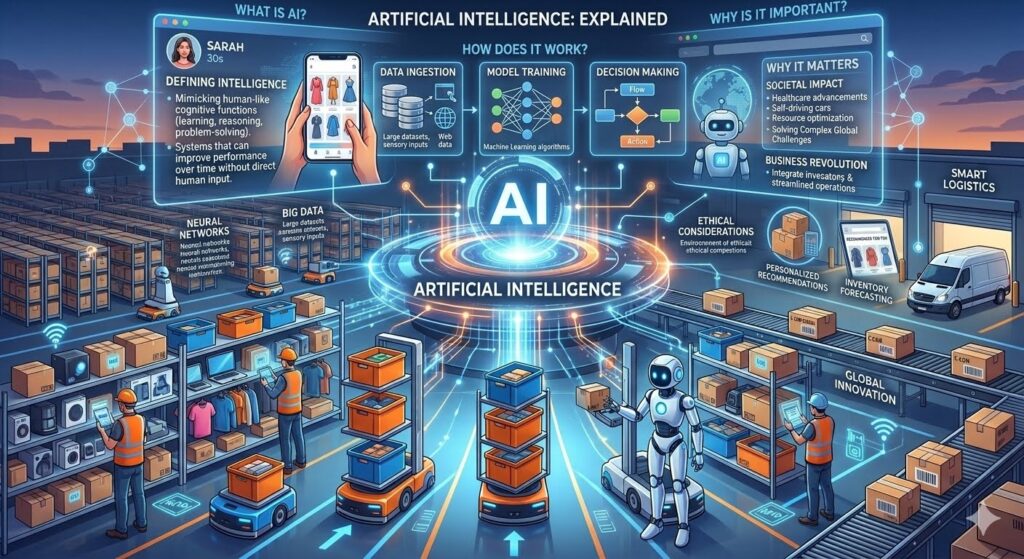
Artificial Intelligence, commonly known as AI, has become one of the most important technologies in the modern world. From smartphones and online shopping to healthcare, education, business, and entertainment, AI is becoming part of everyday life.
Many people use AI tools without even realizing it. Voice assistants can understand spoken questions, streaming platforms can recommend movies, online stores can suggest products, and AI-powered applications can create text, images, videos, and computer code.
But what exactly is Artificial Intelligence? How does it work, and why is it becoming so important?
In this guide, we’ll explain AI in simple terms and explore its uses, benefits, challenges, and future.
What Is Artificial Intelligence?
Artificial Intelligence is a technology that enables computers and machines to perform tasks that normally require human intelligence.
These tasks can include:
- Understanding language
- Recognizing images
- Learning from information
- Solving problems
- Making predictions
- Generating content
- Understanding speech
- Making recommendations
Traditional computer programs usually follow instructions created by humans. AI systems can also learn patterns from large amounts of data and use those patterns to produce results.
For example, an AI system trained with many pictures of cats and dogs can learn characteristics that help it identify whether a new image contains a cat or a dog.
How Does AI Work?
AI works through a combination of data, algorithms, computing power, and machine-learning techniques.
One important area of AI is Machine Learning. Instead of programming every possible answer, developers train a machine-learning model using examples.
The system analyzes the data and identifies patterns.
For example, imagine an online store wants to recommend products to customers. An AI system could analyze previous purchases, searches, product views, and customer preferences. It can then predict which products might interest a particular shopper.
The more useful and relevant data an AI system receives, the better it may become at certain tasks, although AI systems can still make mistakes.
What Is Generative AI?
One of the fastest-growing areas of Artificial Intelligence is Generative AI.
Generative AI can create new content based on instructions provided by a user.
Depending on the system, it can generate:
- Articles
- Images
- Videos
- Music
- Presentations
- Computer code
- Product descriptions
- Marketing ideas
For example, a user can provide a text prompt describing an image, and an AI image-generation system can create a visual based on that description.
Similarly, an AI writing tool can help create a blog outline, rewrite content, summarize information, or generate ideas.
How Businesses Use AI
Businesses across different industries are adopting AI to improve productivity and customer experiences.
Customer Service
AI-powered chatbots can answer common customer questions, provide information, and assist customers at any time.
This can reduce the workload for customer-support teams while giving customers faster access to basic information.
Marketing
AI can help marketers analyze customer behavior, generate content ideas, personalize messages, and identify patterns in marketing data.
Businesses can use these insights to create more relevant campaigns.
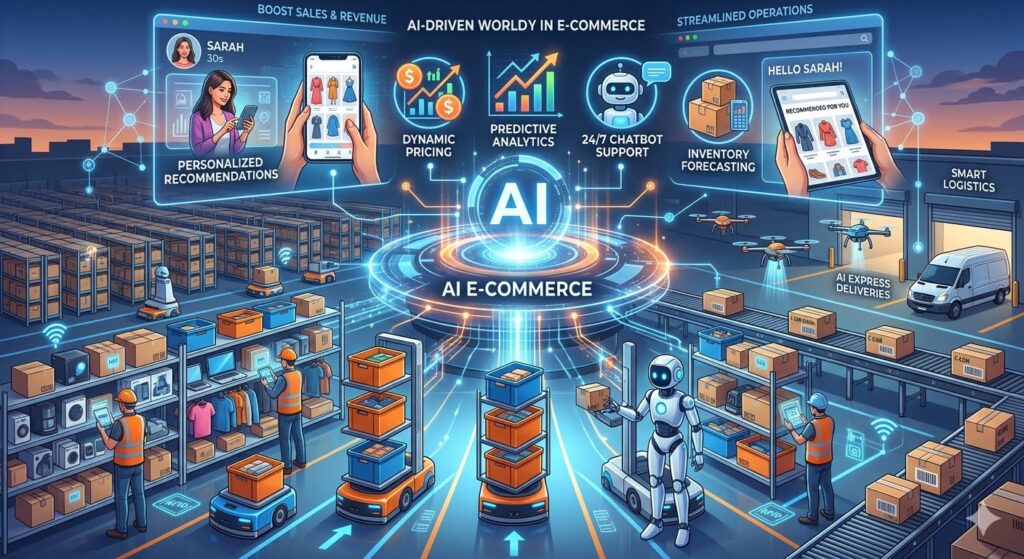
E-Commerce
Online stores can use AI to recommend products based on browsing and purchasing behavior.
For example, if a customer frequently looks at shoes, an AI-powered recommendation system may display similar footwear or related accessories.
Business Analytics
Companies can use AI to analyze large amounts of information and identify patterns that might be difficult to discover manually.
This can support forecasting, planning, and decision-making.
AI in Education
AI is also changing the way people learn.
Students can use AI tools to:
- Understand difficult concepts
- Generate study questions
- Practice languages
- Summarize complicated topics
- Brainstorm ideas
- Receive explanations in simpler language
Teachers and educational organizations can also use AI for lesson planning, administrative tasks, and personalized learning experiences.
However, students should use AI as a learning assistant rather than simply copying AI-generated answers.
AI in Healthcare
Artificial Intelligence is increasingly being researched and used in healthcare-related applications.
AI can assist with tasks such as analyzing medical images, organizing information, identifying patterns in data, and supporting research.
AI does not replace medical professionals. Healthcare decisions require qualified professionals who can consider a patient’s complete situation and use appropriate clinical judgment.
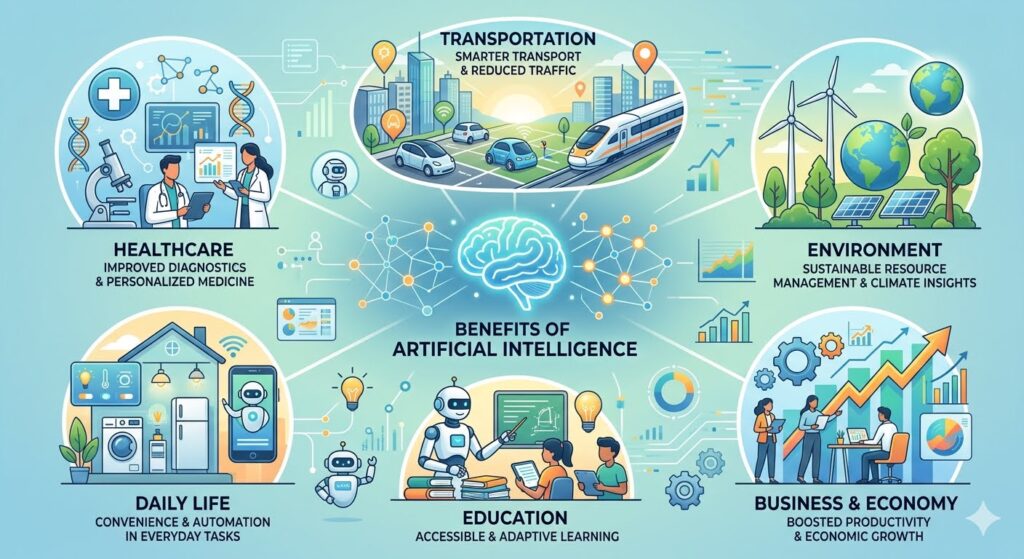
Benefits of Artificial Intelligence
AI offers several potential benefits.
1. Saves Time
AI can automate repetitive tasks and help people complete certain activities faster.
2. Improves Productivity
Businesses and individuals can use AI to support writing, research, analysis, organization, and creative work.
3. Handles Large Amounts of Data
AI systems can process large datasets much faster than humans can manually review them.
4. Personalization
AI can help companies provide personalized recommendations based on individual preferences and behavior.
5. Supports Creativity
Generative AI can help users brainstorm ideas and create drafts for text, images, videos, and other forms of content.
Challenges and Risks of AI
Despite its advantages, Artificial Intelligence also has important challenges.
Accuracy
AI systems can produce incorrect or misleading information. Users should verify important information instead of assuming that every AI-generated answer is correct.
Privacy
AI systems may process large amounts of information, making responsible data handling and privacy important considerations.
Bias
AI models can reflect biases present in their training data. Developers need to evaluate systems carefully to reduce unfair or inaccurate outcomes.
Job Changes
AI may automate some tasks and change the skills required for certain jobs. At the same time, new roles and opportunities can emerge around AI development, implementation, oversight, and creative use.
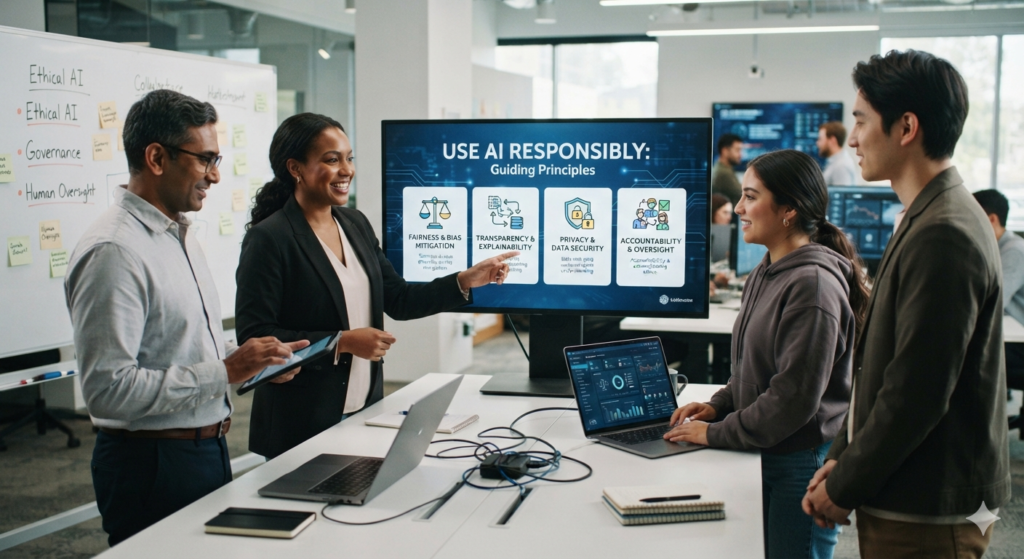
How to Use AI Responsibly
Using AI effectively requires human judgment.
Before using AI-generated information, consider whether it is accurate and appropriate for your purpose.
For important subjects such as financial, legal, medical, or professional decisions, information should be checked against reliable sources and qualified professionals where appropriate.
When creating content with AI, users should also consider originality, copyright, privacy, and the policies of the platform where the content will be published.
The Future of Artificial Intelligence
AI technology is developing rapidly, and its role in everyday life is likely to continue expanding.
Future AI systems may become more capable of understanding different types of information, including text, images, audio, video, and other data at the same time.
Businesses may increasingly use AI for automation, customer service, analysis, software development, marketing, and content creation.
For individuals, AI may become a common productivity tool similar to search engines, smartphones, and other digital technologies.
The most important skill may not simply be knowing how to use AI, but knowing how to use it effectively and responsibly.
Final Thoughts
Artificial Intelligence is transforming the way people work, learn, communicate, shop, and create.
From machine learning and recommendation systems to generative AI, the technology offers powerful opportunities across many industries. However, AI also comes with challenges involving accuracy, privacy, bias, and responsible use.
The future of AI will depend not only on how powerful the technology becomes, but also on how people choose to use it.
Whether you’re a student, business owner, marketer, designer, developer, or content creator, learning the basics of AI can help you understand one of the most influential technologies shaping the digital world.
AI is not simply a technology of the future—it is already becoming part of everyday life.